Showing posts with label Ethics. Show all posts

Saturday, October 20, 2007

That's the Way it Works Here, Kids

Hey, thanks for checking in.

After an extended absence from the keyboard, we're hopeful that, with a little more fiber in the old diet, we'll be much more regular again.

First on the radar screen is an old story, an old story line, and just a little bit 'o irony.

For the old story, Louis "I am not a crook" DeNaples' handed out over a million bucks to Rendel and Mellow and their friends and PACs, and those purchases, err, donations, seem to have paid off. His Mount Airy Casino opens to the public on Monday and, for the time-being at least, he'll not have a grand jury probe whispering behind his back -- thanks to the peculiar brand of political justice seemingly available to every well-connected bag 'o bucks in the good old Commonwealth.

No sooner had the intrepid gambling board given Denaples the green light, notwithstanding his felony fraud conviction and "oft-denied" mob-connections, two independent probes were launched. The federal probe cost the job of a US Attorney who's office was involved into the probe of DeNaples' mob-ties, despite the fact the the US Attorney had given a secret letter of recommendation attesting to his old pal Louis' integrity.

Earlier this month, Pennsylvania Supreme Court "Justice", Ron Castille, secretly granted DeNaples' request that the grand jury be put on ice. Predictably, the secret got out and, omigosh, it was a snafu, never meant it to be a secret . . . yeah, well.

And here's the old story line . . . . The Denaples petition is an unusual one. Under the rules of the Pa Supreme Court, it is referred to a single "Justice" for decision. The "Justice" responsible for receiving those petitions rotates periodically. The DeNaples petition got to Castille's desk just as he rotated into the assignment.

Coincidence? Well, kids, this is Pennsylvania, remember? This story can't be just one slight, ru n of the mill coincidence; nope, here it has got to be a stunning, credulity-stretching, mudda of a coincidence.

The DeNaples petition was drafted and signed by his lawyer, Richard Sprague. And here comes your mudda of a coincidence -- turns out that Dick Sprague's law school roommate was (alleged) "Justice" Ron Castille. (Seems that the only one in the state who noticed that little bit of coincidence was John Baer. Thankfully, there still are a few good journalists around the state.)

Welcome to Pennsylvania.

Oh, the irony I promised?

Guess who got an invite the other day to the Mount Airy private run-through opening tonight?

I was as shocked as anyone. I've never used a slot machine before, but knowing that it is all going to charity and none to Louis "alleged" DeNaples, well, that's just sweet coincidence.

UPDATE:

A tip 'o the hoagie to John Micek for the lead on this one:

"This is Pennsylvania. Things of this nature don't happen in Pennsylvania except because of deals and corruption . . . . This is like putting out a sign to legitimate business people at the borders of Pennsylvania saying better pay up before you come to do business in pennsylvania. That's not the kind of reputation we need." -- PA State Senator --Jeff Piccola(10/21/07) on how Louis “Alleged” DeNaples got his slots parlor.

Monday, September 17, 2007

Ding Dome Gossip

Faithful drinkers of this swill will recall that earlier this year we talked about hearing about talks about settlement talks in the Judicial ethics complaint against Luzerne County's only female jurist, Ann Lokuta.

We had heard from more than one source that Judge Lokuta was offered the option of retiring -- with full benes in place -- and that the Judge was seriously considering the offer. That story was shot down by the Judge's then-new attorneys. Now comes confirmation of the report, of a sort. The pretend newspaper in Scran'en last week "reported" confirmation that a deal was offered to Lokuta late last year, but that the Judge didn't grab it.

Yep, just like a broken clock . . . . .

Thursday, August 30, 2007

Pretend Newspaper Distracts and Misinforms Readers on DeNaples

As if on cue, today's version of the Scran'en fairy tales for adults finally includes some local reporting on the DeNaples probe.

As per usual for the hacks on that paper, the droning report contains no news. It is little more than a list of people seen going in and out of the courthouse (most of whom they don't even bother to talk to after their appearance) where the grand jury is examining the local felon's reputed ties to organized crime, alleged lies on his slots application, and purported illegal donations.

But that information is apparently too sensitive for the readers of this pretend newspaper, as the article fails to even detail what the grand jury is investigating.

But, we are accustomed to the wannabe newspaper's inability to master the most basic of journalism skills. It is what they sneak in at the very end of the piece that sums up what talentless imbeciles are running and writing for that piece of tripe.

Typically for this rag, the piece is salted with apologies for DeNaples -- not surprising since this lousy paper has already declared DeNaples clean and they aren't about to let something like a dual Federal/State investigation call their "news reporting" into question.

So, for example, they rush to point out that one of the people testifying before the grand jury won a defamation case against the Wilkes-Barre Citizen's Voice newspaper last year over an article that suggested the witness was linked to the Federal investigation of NEPA's mob. Of course, that was an unrelated investigation, but the mention serves the purpose of watering down the current investigation. What is stunning is what these no-talent rejects from the Weekly World News elected to leave out of their reporting.

Here's what they said:

"In 2006, a Luzerne County judge awarded Mr. Joseph $3.5 million in a defamation suit against The Citizens' Voice and its parent company over stories published in the wake of the federal raids on Mr. Joseph's Mountaintop home and at least one of his businesses."

What they leave out is that the "parent company" of the Voice and the Scran'en pretend newspaper are one in the same. A real reporter would have disclosed that, but, as we have learned before, the Lynett family, which owns the papers, appears to reject journalistic ethics and seem to ensure that the hacks who work for them are either unable to tell the difference or don't care. (An early-morning inquiry to the "reporter" has not been returned.)

How REAL newspapers have covered the story:

Priest, ex-prosecutor go before grand jury, Philly Daily News, 8/30/07
Priest talks to DeNaples grand jury, Allentown Morning Call, 8/30/07
Allies show as grand jury meets, Philly Daily News, 8/30/07
Denaples' priest faces grand jury, Allentown Morning Call, 8/29/07
More connections emerge between grand jury, Pa. casino licensee, Philly Daily News, 8/29/07
5 witnesses testify in DeNaples probe, Allentown Morning Call, 8/29/07
'Independent' panel members remain unknown, Philly Daily News, 8/28/07
Several appear before grand jury over slots, Allentown Morning Call, 8/28/07
Prosecutor in DeNaples probe to resign, sources say, Allentown Morning Call, 8/23/07
DeNaples link prompts Marino to withdraw from mob probe, Allentown Morning Call, 8/21/07
Marino-DeNaples ties led prosecutor to pull out of probe, Allentown Morning Call, 8/20/07
Sources: Mount Airy owner focus of U.S., state investigation, Allentown Morning Call, 8/19/07

UPDATE: Also on the beat:

The DeNaples story blows up while the Scranton Times sleeps, Noertheast PA Media News
The Electric Connection, Truth, Lies & Peace

And a tip 'o the hoagie to GettysBlog for this golden oldie and the apt (especially considering this) Godfather quote:

"The Pope, the Holy Father himself, has this very day blessed Michael Corleone; an' you think you know better than the Pope?"
--Dominic Abbandando
(Michael's PR Advisor, son of Genco) to reporters (Godfather III).

Thursday, August 23, 2007

DeNaple's US Attorney Pal to Step Down

More smoke . . . .

The Morning Call is reporting tonight that the United States Attorney for the Middle District of Pennsylvania, Thomas Marino, is resigning.

It was recently revealed that Marino was listed as a reference for convicted felon and reputed mob connected slots applicant Louis DeNaples. Marino then recused himself from a Federal probe into DeNaples' alleged illegal contributions by to Rendell, and into DeNaples purported ties to organized crime.

What is unclear from the reports is how long it took Marino to recuse himself from the investigation of his long-time friend. (But, it's gotta give you a warm and fuzzy to realize that the chief Federal law enforcement official in the Middle District has a long-standing friendship with a convicted felon who has long been reputedly associated with the largest organized crime family in his District.)

It was reported last year that, between 2000 and 2005, DeNaples and affiliates contributed over a million bucks to Rendell and Bob Mellow, among others, who were instrumental in naming folk to the gaming board that eventually awarded DeNaples his slots license. Earlier this week, citizens groups filed ethics complaints against one of those board members, whose law firm represented DeNaples and another slots applicant.

Marino was reportedly on the chopping block last year. His resignation could be in preparation for a run at Chris Carney. That'll give the voters in PA's 10th an interesting choice -- friend of convicted felon and "alleged" mob figure versus just another lying politician.

Ethics Complaint Filed Against Casino Lawyer

A couple of citizen-watchdog organizations have filed a formal complaint with the Pennsylvania Supreme Court's Disciplinary Counsel, seeking an investigation of former Gaming Control Board Chairman Thomas "Tad" Decker, Stephen A. Cozen, and seven other Cozen O'Connor attorneys. They allege a slew of conflicts of interest and violations of Pennsylvania's Rules of Professional Conduct for licensed attorneys.

Cozen O'Connor represents Louis DeNaples, owner of the Mt. Airy Resort and Casino. DeNaples is the subject of Federal and State probes into potential illegal campaign contributions to Decker's college-friend (Rendell) and Denaples' alleged affiliation with William "Big Billy" D'Elia, the purported head of the Bufalino crime family in Northeastern Pennsylvania.


Decker worked for Cozen O'Connor as a managing partner until Rendell made him chair of the newly formed Pennsylvania Gaming Control Board in 2004. Decker left the Board earlier this month and took over the reigns at Cozen O'Connor as President/CEO. Cozen O'Connor represents SugarHouse Casino, as well as DeNaples. (The law prohibits former board members from representing applicants before the board for two years.)

The ethics complaint lists a variety of asserted conflicts of interest, including:

* During Decker's tenure, Cozen O'Connor represented SugarHouse in several matters before the Supreme Court and possibly administrative proceedings before the PGCB.
* On the same day as Decker stepped down as Chairman of the PGCB, he returned to a raise and promotion at Cozen O'Connor which continues to represent two casinos with business before the PGCB.
* Decker only recused himself from the final vote on SugarHouse, but presided over the deliberations regarding the site selection of all 12 casino licenses, including SugarHouse Casino.
* Decker neglected to recuse himself from voting and deliberating on the four other Philadelphia casino applicants, and hence he was still able to influence the outcome of the vote.
* Decker continued to direct the defense of the Gaming Control Board's licensing decisions before the state Supreme Court, despite outstanding questions regarding his continuing ties to Cozen O'Connor.
* After hiring Tad Decker, Cozen O'Connor became ineligible to represent SugarHouse and Mount Airy Lodge. By continuing to do so, Cozen O'Connor and Tad Decker are in violation of the Supreme Court's Rules of Professional Conduct for licensed attorneys.

The complainants are awaiting word on whether their complaint will be investigated. (Poisonally, I don't think they ought to hold their breaths.)

Tuesday, June 12, 2007

Well, If You Don't Have Anything Good to Say . . . .

The May 25 Quarterly Report on news coverage by the Project for Excellence in Journalism ("PEJ") reveals that Fox Noise viewers received less information about the Iraq War than did viewers of any other cable news program. (We already knew that Fox Noise viewers were the least informed overall.)

Now, we learn that, according a PEJ study of over 17,000 stories aired or published in the media during the first quarter of the year, Fox Noise viewers received about half the information on Iraq that viewers of CNN or MSNBC received.

The study tells us that, among the three cable news television outlets, coverage of Iraq accounted for about 28% of the news aired on CNN and MSNBC. Over at Fox Noise, their under-informed devotees got about half that -- 15%. But, the Noise channel had to fill that information gap with something. So, the Noise viewers will likely be pleased to know that they received more coverage of Anna Nicole Smith than anyone else in the cable universe. (In fact, Fox Noise gave its fans exactly twice as much coverage of the dead celebrity than the average of CNN and MSNBC.)

More interesting than the gross figures, is the breakdown of the nature of the Iraq coverage. PEJ coded the Iraq news as reports on the policy debate, on events on the ground in Iraq, and homefront coverage.

Overall, the policy debate over the Iraq war accounted for about 12% of the 17,000+ stories reviewed from all media sources (including newspapers, radio, network and cable news). This was more than the combined coverage given to events on the ground and homefront impacts of the war.

Considering that the policy debate on Iraq is just about the most important national debate we have had in at least a decade, covering it seems appropriate regardless where one's seat on the political spectrum may be. On cable news, Fox's coverage of the policy debate was exactly half that provided by the other cable news outlets. One-Half!

This is what happens when a news outlet abandons any semblance of impartiality and invests itself in the outcome of the events that it covers (we examined this from a local perspective last fall in "Trashing the First Amendment"). The Noise ownership and staff were cheerleaders for war and, now that things have gone even worse than most expected, they are eager to fill their time with non-news such as the Anna Nicole Smith nonsense.

Fox Noise defends itself by claiming that they publish a more balanced perspective -- producing more so-called "positive" stories on Iraq than negative. I'm not sure in what universe 3500 dead American kids, tens of thousands maimed American boys and girls, hundreds of thousands dead and maimed Iraqi civilians, and millions of Iraqi forced to leave their homes, produce many positive stories, but so be it.

That doesn't answer why the tiny comparative coverage of the policy debate. The Noise Channel gave about the same amount of time to events on the ground in Iraq as its competition -- it is in the coverage of the policy debate that Noise viewers are the least informed.

After pimping the war and promising rose petals at the feet of Americans, when the shit storm happened, Fox Noise simply retreated, pretending it was all okay.

Calling this travesty a news organization fouls the water.

Wednesday, February 21, 2007

Ethics, NEPA Style

In perusing the NEPA "newspapers", so-called, for my rant about the inept response in dem parts to the recent snow storm, another item attracted my attention.

On Sunday past, a state superior court judge was the feature speaker at a local Republican Party conclave. The judge's speech was a passionate statement of support for the racist Hazleton immigration ordinance and its bigoted Mayor; not to be content, the judge also declared that the first amendment ought be rescinded for those who don't live in Hazleton: “I don’t think that the debate about the Hazleton ordinance should be allowed to be set by people who are not from the area". Yeah, well, anyway. That the judge, a Hazleton resident, a Republican, had such views isn't terribly surprising.

What caught my attention is that he was expressing them, for a political organization, even whilst a legal challenge to the ordinance was underway. The local newspaper said that the judge "prefaced his remarks by saying that the judicial code of ethics prevented him from speaking on the court case involving Hazleton’s Illegal Immigration Relief Act, he defended city Mayor Louis Barletta and council members as honorable people who shouldn't’t be berated by outsiders."

Indeed. Actually, that's not exactly what the Code of Judicial Conduct says. And if the state of journalism in NEPA wasn't as pathetic as it is, a real reporter would have known that -- or at least would have looked it up -- and called the judge on it. Let us begin with the first, informing Canon of that Code:
An independent and honorable judiciary is indispensable to justice in our society. Judges should participate in establishing, maintaining, and enforcing, and should themselves observe, high standards of conduct so that the integrity and independence of the judiciary may be preserved. The provisions of this Code should be construed and applied to further that objective.
Everything in the Code is to be read in light and supportive of Canon 1. And, what does the Code actually say about judges giving speeches and talking in public? Well, the judge got part of it correct, Canon 3 does prohibit comment about pending matters:
Judges should abstain from public comment about a pending proceeding in any court . . . .
Apparently, the judge thinks that means it is okay to talk about the issues surrounding a pending court case, as long as he disclaims that he is talking about that case. Here are some of his comments:
Stevens said local problems caused by illegal immigration include citizens having to pay for illegal immigrants’ “visits late at night to emergency rooms when no one’s around.” He also knows first-hand that law enforcement is frustrated when the federal Bureau of Immigration and Customs Enforcement tells officers who have apprehended illegal immigrants to “let them go.”

Stevens called for “common sense” decisions in courts when dealing with illegal immigrants. He said the federal government should allow state and local police to enforce immigration laws, county district attorneys to prosecute offenders and county and state judges to hear the cases.

Stevens said the money the federal government would save could be given to local governments for enforcement. “The law will be enforced and we won’t have the strain on our city resources that we have now.”
And, to be sure, judges are encouraged to speak out on matters relating to the administration of justice, but to do so in a way that will not suggest partiality on any issue:
Judges, subject to the proper performance of their judicial duties, may engage in the following quasi-judicial activities, if in doing so they do not cast doubt on their capacity to decide impartially any issue that may come before them: A. They may speak, write, lecture, teach, and participate in other activities concerning the law, the legal system, and the administration of justice.
But none of this is proper justification for a sitting appellate court judge to wax on in support of an ordinance being challenged in court -- even if not his own court. But, more fundamentally, what the hell was the judge doing as the featured speaker at a partisan political event? Forget what he was talking about, why was he there at all? Remember Canon 1 -- it is first for a reason:
An independent and honorable judiciary is indispensable to justice in our society.
Here's the official comment to the Model Code on which the Pennsylvania Code is based, explaining the importance of Canon 1:
Deference to the judgments and rulings of courts depends upon public confidence in the integrity and independence of judges. The integrity and independence of judges depends in turn upon their acting without fear or favor. A judiciary of integrity is one in which judges are known for their probity, fairness, honesty, uprightness, and soundness of character. An independent judiciary is one free of inappropriate outside influences. Although judges should be independent, they must comply with the law, including the provisions of this Code. Public confidence in the impartiality of the judiciary is maintained by the adherence of each judge to this responsibility. Conversely, violation of this Code diminishes public confidence in the judiciary and thereby does injury to the system of government under law.
Proceeding from these first principles, consider Canon 7, o'erlooked by the judge and reporter here:
A judge . . . should not . . . make speeches for a political organization.
Regardless the topic of the speech, a sitting judge should not even be attending a Republican Party event -- much less being the featured speaker, much, much less expounding on an issue hot in the courts in NEPA.

Judges shouldn't be attending partisan, fundraising events like the local Republican Party Lincoln Day dinner.

Period.


NOTE:

WE ARE MOVING!!! For now, the old Blogger address will bring you to the new location -- but that can change at any time. Please update your Blogroll, Links, and Bookmarks NOW:

www.abigfatslob.com

Click Here to Blogroll A Big Fat Slob!

Tuesday, January 23, 2007

Sore Winners

They got the so-called grassroots lobbying provisions out of S.1 (based on lies like this: "Section 220 of S. 1, the lobbying reform bill currently before the Senate, would require grassroots causes, even bloggers, who communicate to 500 or more members of the public on policy matters, to register and report quarterly". We dissected that lie here.) Nevertheless, wingnutz like the so-called "American Family Association of PA (f/k/a AFAof NWPA)", are pouring out more lies about the portion of the bill that wasn't even passed (thanks to weak-knees like Arlen Specter who caved to far right wingnut pressure). You know you were on to something when they are still whining about it even a week after they won the fight.

Thursday, January 18, 2007

Senate Passes Weakened Ethics Bill

Senate Democrats, anxious to demonstrate that there is a "new" way of doing the people's business, struggled through a week of Republican maneuvers and wingnut opposition to pass ethics reform legislation by an overwhelming 96-2 vote late Thursday evening.

The vote came after the bill, S.1, appeared dead in the water due to the proposal to attach a line-item veto amendment to the legislation. Harry Reid offered a compromise, permitting the line-item legislation to come up before the spring recess. But Senator Byrd vigorously opposed the deal on the principle that it was what he termed "legislative blackmail". After repeated quorum calls, the Senate chamber began filling up around 8 pm and it appeared a compromise had been reached.

The Democrats would permit the line-item veto legislation to be proposed for attachment to the minimum wage legislation that the Senate is expected to take up on Monday.

S.1 did not make it through unscathed, however. Wingnut misrepresentation over what the bill actually said carried the day, as the Bennett amendment, to strip out the guts of Section 220 of the bill, requiring stealth advertisers, like the swiftboaters, to register under the lobbying rules, was passed. The Senate also refused to accept an amendment creating an Office of Public Integrity to have authority to investigate ethical lapses of members of Congress -- the Congress wants to retain that power (too much danger inherent in turning it over to an independent agency).

Nevertheless, the bill finally did pass. The Senate Bill, as passed, would:
--Bar lawmakers from accepting gifts and travel paid for by lobbyists.
--Extend from one to two years the time a former member must wait before he lobbies Congress.
--Deny pensions to lawmakers convicted of serious crimes.
--Require more reporting by lobbyists on their activities.
--Require public disclosure of those home-state projects.
--Require senators hitching rides on private jets to pay full charter rates rather than the current practice of paying the far cheaper equivalent of a first class ticket.
Next month, the House will take up similar legislation on lobby reform and set up a conference to work out the final reforms.

"Are the memories around here so short?"

The Senate has been working on Senate Bill 1 this week. S.1 is the Legislative Transparency and Accountability Act of 2007, designed to break, or at least pour a little light on, the ties between lobbyists, big money interest groups, and Congress. (We covered the false allegations being made against the bill earlier this week.)

The Republicans, however, have stalled the effort -- despite a significant number of Republicans claiming to support the bill -- by interposing an unrelated amendment to grant the President a form of line-item veto. This, despite a recent Supreme Court opinion declaring the line-item veto unconstitutional. Senator Byrd called the Republicans on the tactic, speaking from the floor of the Senate, clutching a copy of the Constitution:
Mr. BYRD. Mr. President, I rise tonight at this late hour. The hour is late and the night is black. I rise tonight to shine a bright light on political chicanery that is playing out on the Senate floor.

In November, America voted for a change. The people sent a strong signal that they wanted less partisanship and more accountability in Washington. In response to the voters, Senator Reid, Senator Feinstein, and Senator McConnell put before the Senate an ethics reform bill that would add transparency and accountability to the legislative process. They should be proud of their product, and the Senate has had a good debate thus far on the bill.

But wait, wait, wait 1 second. Before we can clear the way for greater accountability and sunshine into the way work gets done in these halls, the Senate is being blackmailed into an assault on the Congress's single most precious and most powerful authority--the power of the purse. That is the most powerful authority we have: the power of the purse.

Tonight, this reform bill is threatened by an effort by our colleagues on the other side of the aisle to give the President line-item veto authority. No vote on the line-item veto, they say, and no ethics reform. That is nothing more than legislative blackmail, and I, for one, will not pay the price. No one should stand still when this Constitution, which I hold in my hand, is the hostage. No one should stand still, I repeat, when this Constitution, which I hold in my hand, is the hostage.

This line-item veto authority would grant tremendous and dangerous new power to the President. He would have unchecked authority to take from the Congress the power of the purse, a power that the constitutional Framers thought was absolutely vital to protecting the people's liberties.

It was just 8 years ago that the U.S. Supreme Court decided that the line-item veto was unconstitutional. Now our colleagues--some of them--on the other side of the aisle are threatening to hold up the ethics reform bill in an effort to hand the President another line-item veto authority. Are the memories around here so short?

Are the memories around here so short?

We have a President who already has asserted too much power. This is a blatantly gross attempt to take even more power for the President and strip away power from the people.

This President claimed the unconstitutional authority to tap into the telephone conversations of American citizens without a warrant or court approval.

This President claimed the unconstitutional authority to sneak and peek, to snoop and scoop, into the private lives of the American people.

This President has taken the Nation to a failed war based on faulty evidence and the misrepresentation of facts. And many Senators voted not realizing that was what was being done when we voted on the war resolution.

So I say, this President has taken the Nation to a failed war based on faulty evidence and an unconstitutional doctrine of preemptive strikes. More than 3,000 American sons and daughters have died in Iraq in this crazed Presidential misadventure.

And what is the response of the Senate? To give the President even more unfettered authority? To give him greater unchecked powers? We have seen the danger of the blank check. We have lived through the aftermath of a rubberstamp Congress. We should not continue to lie down for this President or any other President.

Of course, this President wants to take away Congress's power of the purse. When Congress has the sole ability to shut down these unconstitutional practices, when Congress is asking tough questions and demanding truthful answers about this war, when Congress is taking a hard look at finding ways to begin to bring our troops home, over the objections of this administration, the President's response is to demand that the Congress give away its most crucial power. Silence the Congress. Ignore the people. Strip away our constitutional protections and one may just as well strip away the people's liberties lock, stock, and barrel. Strip away the power of the Congress, the power of the people, and amass all power behind the fences and secret doors of the White House.

No Senator should vote to hand such power to the President. No American should stand for it--not now, not ever.

If our colleagues on the other side of the aisle want to stop the Senate's effort to add transparency and accountability to the legislative process, that is their right and their choice. But I will not blink. I cannot look the other way. We should get on with the business at hand and pass meaningful ethics reform legislation. But we should never, never, hand away those precious constitutional powers--the last protections of the people's liberties, vested in the people's representatives in this Congress--to any President.

We have each taken an oath to protect and defend this Constitution of the United States. Here it is. I hold it in my hand. I say again, we have each taken an oath to protect and defend this Constitution of the United States. And it is about time we did protect and defend that Constitution of the United States.

Mr. President, I thank the Chair. I thank all Senators.

I yield the floor and suggest the absence of a quorum.

Tuesday, January 16, 2007

Wingnut Lies About S.1

For over a month now, right wingnutz have been in a tizzy over S. 1, the Legislative Transparency and Accountability Act of 2007. Their complaints center on Section 220 of the bill. Their talking points about that section are filled with dramatic and alarming claims. But, as you might expect when considering the source, they speak falsely.

Uniformly, the wingnutz pretty much tell you what the bill says, without linking to or quoting the actual language. So, to start the discussion, let us take a look at (gasp -- here's a thought) the actual words:
SEC. 220. DISCLOSURE OF PAID EFFORTS TO STIMULATE GRASSROOTS LOBBYING.

(a) Definitions- Section 3 of the Act (2 U.S.C. 1602) is amended--

(1) in paragraph (7), by adding at the end of the following: `Lobbying activities include paid efforts to stimulate grassroots lobbying, but do not include grassroots lobbying.'; and

(2) by adding at the end of the following:

`(17) GRASSROOTS LOBBYING- The term `grassroots lobbying' means the voluntary efforts of members of the general public to communicate their own views on an issue to Federal officials or to encourage other members of the general public to do the same.
`(18) PAID EFFORTS TO STIMULATE GRASSROOTS LOBBYING-
`(A) IN GENERAL- The term `paid efforts to stimulate grassroots lobbying' means any paid attempt in support of lobbying contacts on behalf of a client to influence the general public or segments thereof to contact one or more covered legislative or executive branch officials (or Congress as a whole) to urge such officials (or Congress) to take specific action with respect to a matter described in section 3(8)(A), except that such term does not include any communications by an entity directed to its members, employees, officers, or shareholders.
`(B) PAID ATTEMPT TO INFLUENCE THE GENERAL PUBLIC OR SEGMENTS THEREOF- The term `paid attempt to influence the general public or segments thereof' does not include an attempt to influence directed at less than 500 members of the general public.
`(C) REGISTRANT- For purposes of this paragraph, a person or entity is a member of a registrant if the person or entity--
`(i) pays dues or makes a contribution of more than a nominal amount to the entity;
`(ii) makes a contribution of more than a nominal amount of time to the entity;
`(iii) is entitled to participate in the governance of the entity;
`(iv) is 1 of a limited number of honorary or life members of the entity; or
`(v) is an employee, officer, director or member of the entity.
`(19) GRASSROOTS LOBBYING FIRM- The term `grassroots lobbying firm' means a person or entity that--
`(A) is retained by 1 or more clients to engage in paid efforts to stimulate grassroots lobbying on behalf of such clients; and
`(B) receives income of, or spends or agrees to spend, an aggregate of $25,000 or more for such efforts in any quarterly period.'.

(b) Registration- Section 4(a) of the Act (2 U.S.C. 1603(a)) is amended--

(1) in the flush matter at the end of paragraph (3)(A), by adding at the end the following: `For purposes of clauses (i) and (ii), the term `lobbying activities' shall not include paid efforts to stimulate grassroots lobbying.'; and

(2) by inserting after paragraph (3) the following: `(4) FILING BY GRASSROOTS LOBBYING FIRMS- Not later than 45 days after a grassroots lobbying firm first is retained by a client to engage in paid efforts to stimulate grassroots lobbying, such grassroots lobbying firm shall register with the Secretary of the Senate and the Clerk of the House of Representatives.'.

(c) Separate Itemization of Paid Efforts To Stimulate Grassroots Lobbying- Section 5(b) of the Act (2 U.S.C. 1604(b)) is amended--

(1) in paragraph (3), by--

(A) inserting after `total amount of all income' the following: `(including a separate good faith estimate of the total amount of income relating specifically to paid efforts to stimulate grassroots lobbying and, within that amount, a good faith estimate of the total amount specifically relating to paid advertising)'; and

(B) inserting `or a grassroots lobbying firm' after `lobbying firm';

(2) in paragraph (4), by inserting after `total expenses' the following: `(including a good faith estimate of the total amount of expenses relating specifically to paid efforts to stimulate grassroots lobbying and, within that total amount, a good faith estimate of the total amount specifically relating to paid advertising)'; and

(3) by adding at the end the following: `Subparagraphs (B) and (C) of paragraph (2) shall not apply with respect to reports relating to paid efforts to stimulate grassroots lobbying activities.'.

(d) Good Faith Estimates and De Minimis Rules for Paid Efforts To Stimulate Grassroots Lobbying-

(1) IN GENERAL- Section 5(c) of the Act (2 U.S.C. 1604(c)) is amended to read as follows:

`(c) Estimates of Income or Expenses- For purposes of this section, the following shall apply:
`(1) Estimates of income or expenses shall be made as follows:
`(A) Estimates of amounts in excess of $10,0000 shall be rounded to the nearest $20,000.
`(B) In the event income or expenses do not exceed $10,000, the registrant shall include a statement that income or expenses totaled less than $10,000 for the reporting period.
`(2) Estimates of income or expenses relating specifically to paid efforts to stimulate grassroots lobbying shall be made as follows:
`(A) Estimates of amounts in excess of $25,000 shall be rounded to the nearest $20,000.
`(B) In the event income or expenses do not exceed $25,000, the registrant shall include a statement that income or expenses totaled less than $25,000 for the reporting period.'.

(2) TAX REPORTING- Section 15 of the Act (2 U.S.C. 1610) is amended--

(A) in subsection (a)--

(i) in paragraph (1), by striking `and' after the semicolon;

(ii) in paragraph (2), by striking the period and inserting `; and'; and

(iii) by adding at the end the following: `(3) in lieu of using the definition of paid efforts to stimulate grassroots lobbying in section 3(18), consider as paid efforts to stimulate grassroots lobbying only those activities that are grassroots expenditures as defined in section 4911(c)(3) of the Internal Revenue Code of 1986.'; and

(B) in subsection (b)--

(i) in paragraph (1), by striking `and' after the semicolon;

(ii) in paragraph (2), by striking the period and inserting `; and'; and

(iii) by adding at the end the following: `(3) in lieu of using the definition of paid efforts to stimulate grassroots lobbying in section 3(18), consider as paid efforts to stimulate grassroots lobbying only those activities that are grassroots expenditures as defined in section 4911(c)(3) of the Internal Revenue Code of 1986.'.
Now, let's take a look at some of the wingnut claims.

The Pennsylvania Family Institute(PAFI) seems as good a place as any to start (they are just convenient. Swing a dead cat and look at the Talking Points of the first wingnut org that you hit, they will be saying the same thing.)

The PAFI alarm contains what appears to be a link to Senate Bill 1. But, when a faithful reader clicks on that link they are transported not to the Bill itself, but to the Family Research Council's Talking Points on the bill. After this little bit of misdirection, the PAFI tells it's blind sheep readers that Section 220 redefines lobbying to include grassroots lobbying:
Sec. 220 subjects "grassroots lobbying" to government regulations. Grassroots lobbying has long been seen as separate and distinct from “lobbying activity,” but it would now be subject to government regulation.
Oh. Horrors. Except that, by not providing their readers with a link to the actual bill, recipients of this wingnut org's "alert" would not know that, in fact, the actual language of the bill is to the opposite effect, and carves out specific protection for and exclusion of actual grassroots efforts from application of the lobbying reform legislation. Thus, Section 220 says:
`Lobbying activities include paid efforts to stimulate grassroots lobbying, but do not include grassroots lobbying.'
Whew. But, wait, what's this . . . more horrors apparently lay hidden in 220. The PAFI tells its shocked members that under this legislation, PAFI newsletters would be subject to reporting and the PAFI could be fined $100,000 if it screws up:
This means that organizations like the Pennsylvania Family Institute, and larger organizations like Focus on the Family and Family Research Council, will need to go through miles of red tape, which include notifying Congress 45 days prior to engaging in the specific grassroots activity, which could prevent us from posting an urgent message like this to you about a specific vote. We could even face $100,000 fines for running afoul of the oppressive regulations.
Calm down, dear reader. As you might suspect by now, the PAFI and the other wingnutz repeating these Talking Lies Points have not gotten it exactly right. In fact, they've got it exactly wrong. In fact, here is what that nasty 220 actually says about such things:
The term `paid efforts to stimulate grassroots lobbying' means any paid attempt in support of lobbying contacts on behalf of a client to influence the general public or segments thereof to contact one or more covered legislative or executive branch officials (or Congress as a whole) to urge such officials (or Congress) to take specific action with respect to a matter described in section 3(8)(A), except that such term does not include any communications by an entity directed to its members, employees, officers, or shareholders.
Hooboy. I hope that PAFI didn't pay too much to whomsoever it hired to interpret the bill for its members . . . .

Kids, the bottom line is that, no matter how many times the wingnutz say it, and no matter how many of them say it, the fact is that Senate Bill 1 does NOT, by its terms, apply to grassroots lobbying and does NOT require advocacy organizations to register simply because they send email alerts and newsletters to their members. Instead, the bill is designed to get at the swiftboater organizations and the people who (until passage of this bill) secretly pay them to rouse rabble.

Friday, December 22, 2006

A Little Gouging for the Holidays, Part Deux

NOTE: We are re-running this post, originally published December 5, because we have had a response from Turkey Hill, and some newly discovered information.

First, the original post:
A friend's missive arrives today, recounting the tornado that hit his sleepy little burg outside Wilkes-Barre last Friday. I've passed through the town of Mountaintop a few times, not much to see there folks.

But I guess there was plenty to see Saturday morning, after this thing ripped through town, putting the mountain in the dark for three days.

All, that is, save for the Turkey Hill store and gas station. It must have been equipped with back-up power because it stayed open through out the weekend. It was the only place to get gas -- the other stations were shuttered for lack of power.

The Turkey Hill manager decided to take advantage of the situation -- by raising the prices at the pump. Before the power was knocked out, according to my correspondent, Turkey Hill sold regular for $2.35 -- which was the going rate in the town. After the power outage knocked out the competition, the store raised the price to $2.37. When the power was restored a few days later, they knocked it back to $2.35. I guess the residents there should be grateful that the Turkey Hill didn't get really greedy and raise it double-figures.

On the other hand, a locally-owned supermarket there, Carrone's, whose competition was knocked out by a direct hit on their building, went the other way. They brought in a tractor-trailer load of water and was handing it out -- free of charge -- all through the weekend and beyond. (My pal tells me quite a few people in the area are serviced by private wells.)

Big difference in attitude between the locally-owned retailer and the chain store. Keep that in mind when shopping this Holiday season.
Now, the Turkey Hill response:
I can assure you that we did not make any gasoline price changes during the power outage. I verified this with our databases. I spoke with the District Advisor as well and he was not aware of any issues with the price sign, but it could be possible that while the generator was running there may have been some sort of false signal to the electronic price sign.

I thank you for giving me the opportunity to set the record straight. I would be happy to discuss the issue with the individual who reported the pricing to you as well.
This from Gabriel Olives, Director MIS/Petroleum, Turkey Hill Minit Markets.

Well, Gabe -- can I call you "Gabe"? -- this is not, as another more famous blogger likes to say, my first trip to the rodeo.

A "false signal" to the price sign, despite no one being aware of any problems with the price sign. Clever. But I am not buying it, so to speak.

Since I ran the post, I have heard from other Mountaintop residents who confirmed the original report of my friend. BTW, all of them -- and to my knowledge they don't know one another -- said that they are no longer patronizing the Turkey Hill as a result.

As for myself, I usually opt for the name brand over the gas de jour offered by chains like Turkey Hill -- I resent that branded gas chains, like Turkey Hill, pay 3-6 cents less per gallon than the name-brand independent station owners (due to the higher costs of the fuel-improving additives in the name-brand gas). Yet, the Turkey Hills of the world typically charge the same as the guy across the street shilling BP, or whatever. But, I am going elsewhere for my coffee and newspapers when on the road. I figure that alone has got to cost Turkey Hill at least $12 a year.

So, take that!

But, Gabe, sometimes it is better not to protest too much. I did a little digging (very little, as the nuggets were just lying just below the surface) and discovered that neither Turkey Hill nor this very Mountaintop, PA outlet are strangers to gouging charges.

Back in April it was reported that several Turkey Hill stores, INCLUDING the Mountaintop outlet, agreed to pay several thousand in civil fines for gouging at the pump:
Without a gouging law in place in Pennsylvania, of the more than 1,000 gas gouging complaints the state received last year, only two companies were fined under the consumer protection law in place.

Lancaster-based Turkey Hill agreed to pay $6,000 in fines for prices charged at stores in Shillington, Berks County, and Mountain Top, Luzerne County. . . . The Valley General Store in Huntingdon County also agreed to pay a $1,000 fine. Under the agreement, both companies did not have to admit they gouged customers.
Now, isn't that special?

Turkey Hill, one of only two companies in the entire damned Commonwealth fined for gas gouging, including at this Mountaintop store that (oh, okay) "reportedly" raised its prices during an emergency. In another report, Pennsylvania Deputy Attorney General Barry Creany was quoted, talking about Turkey Hill, saying "It is taking unfair advantage of being greedy in a situation where there is a dire need."

Indeed.

But now, you tell us, you are "Shocked. Shocked!", you say, "To find gouging in Mountaintop's Turkey Hill!". Well, here's my suggestion to those who contacted me about the "apparent" Mountaintop emergency gouging:

Office of Attorney General
Bureau of Consumer Protection
101 Penn Avenue
Scranton, PA 18503
(570) 963-4913

Pa Attorney General, Consumer Protection Hotline: 800-441-2555

PA Attorney General Online Complaint Form.

Thursday, December 21, 2006

Money Talks

Donations of over a million dollars to Governor Rendell and Democratic State Senate Leader Bob Mellow, and others, seem to have paid off for Louis Denaples. Despite his fraud conviction for taking advanatage of the Agnes flood disaster and the persistent, documented, allegations of his mob ties, the landfill and bank owner from NEPA, who the slot commission was told was "a crook with ties to organized crime", purchased won his slots license yesterday.

Wednesday, December 20, 2006

Trust, But Verify? Slots Applicant With Alleged Mob Ties Proposes Oversight Board

From today's Pocono Record:
Facing new doubts about the "suitability" of Mount Airy Lodge owner Louis DeNaples, a Mount Airy official Tuesday proposed creating an independent audit committee to oversee gambling operations at the resort if it obtains a casino license.
Sooo, Denaples wants to create a new state entity just to keep an eye on him? And that's supposed to make those who question his alleged ties to organized crime sleep better? Is the new state board going to have access to all of his phone calls, and those of his associates? Are they going to be able to install listening devices and cameras everywhere anyone with anything to do with the casino goes?

If Denaples is a pure as he claims, the proposed three-member oversight board is unnecessary. If he is as mobbed-up as his detractors say, it is a grossly inadequate measure.

Either way, it is a desperate and cynical ploy.

A decision on the slots licenses is scheduled for today.

Wednesday, December 06, 2006

Just a Family Business, Man

There are five applicants vying for two slots licenses. In the Poconos there are two applicants and the betting is that one of the available licenses will go to the Poconos.

The contenders there include Louis Denaples, an allegedly mob-tied felon from NEPA, who pled "no contest" to fraudulently cashing in on the 1972 flood that hit the Wilkes-Barre area, from which it has not yet recovered. More recently, in 2001, the Internal Revenue Service filed an affidavit in U.S. District Court outlining contacts and payments Denaples allegedly made to William "Big Billy" D'Elia, whom law enforcement identified as the head of the Buffalino crime family in Northeastern Pennsylvania.

His competitor in the region is the Pocono Manor, recently purchased by a group headed by New Jersey real estate developer Greg Mazel. Mazel has spent millions, bringing in some of the most respected consultants in the gaming, resort and convention business, to help his group put together a full-scall resort, convention, and retail plan for developing the Pocono Manor property, which has continued operating as a world-class resort since Mazel purchased it. (Denaples levelled the Mount Airy property when he bought it, and it now sits as a massive eyesore in the Poconos.)

Even a cursory review of the two plans suggests that the Pocono Manor plan is more well thought out, more likely to bring non-gambling business to the Poconos, and more professionally put together. The Pocono Manor plan calls for the operations to be run by experienced resort, retail, and gambling professionals. Denaples will turn over significant responsibility to his 37-year old daughter, who has a dental degree (to be sure, there are gambling pros on the Denaples team -- but this will be a family-run business).

But, the allegedly linked-in Denaples plan has something that the Pocono Manor plan doesn't -- over a million dollars in donations to Rendell and other top state lawmakers and judges over the last five years. That includes nearly $300,000 to Bob Mellow, Democratic State Senate Leader, and committees he controls.

We aren't going to say that that bought Denaples a seat at the table -- but Mellow appointed Denaples friend and former lawyer, William Conaboy (from Scran'en), to the commission that doles out slots licenses. Conaboy is on the Board of directors of the bank that Denaples controls and is chairman of the board. Conaboy is also on the board of directors of Lackawanna Community College in Scran'en.

Also serving on the Board of Directors for the Lackawanna College along with Denaples' lawyer are Albert Magnotta and Dominic Denaples -- Louis' brother. Magnotta is the chief engineer on Denaples' slots project. Dominic Denaples, who is partners with his brother in some ventures, is chairman of the college’s board. All that is significant because, when Conaboy had to resign from the slots board, Mellow appointed the president of Lackawanna College as his replacement. Mellow's press release forgot to mention the Denaples ties.

Oh, yeah, Denaples is telling everyone there's no conflict because his brother has nothing to do with the Mount Airy project. Here's the photo and caption from a local paper on the "ground-breaking":

"Former Mount Airy Lodge owner Frank Martens, left, is joined Monday by Louis, Dominick and Lisa DeNaples for a ground breaking ceremony for the proposed Mount Airy Resort and Casino."
Yeah, well.

With "Denaples Family" juice, is there any doubt who is going to get the license -- a professional, full concept plan designed to bring retail, convention, resort, and gambling business to the Poconos, or the empty lot owned by a felon, with reported mob-ties, who was called at the slots hearing "a crook with ties to organized crime"?

One guess.

Thursday, November 30, 2006

Inquiring Minds Want to Know

It seems that we've attracted the attention of government workers at the state and federal level today.

SOMEone at the United States House of Representatives spent a fair amount of time today searching the internets for information on "a big fat slob" (using Google and the IE browser on a Windows machine hooked up the the House network):
Domain Name: house.gov(United States Government)
IP Address: 143.231.249.# (Information Systems, U.S. House of Representatives)
ISP: Information Systems, U.S. House of Representatives
Referring URL: http://www.google.co...:en&q=a big fat slob
Search Engine: google.com
Search Words: a big fat slob
Now, I don't know that this was related to my articles about Reprehensible Tim Murphy, or my email inquiries sent to his Communications Director, yesterday and today. But, one can make a reasoned guess. I hope they found out what they wanted to find out.

And, I am sure that they also missed the irony here. My write-up on Reprehensible Murphy had to do with his use of his campaign staff to investigate the backgrounds of citizens who dared write letters to the editor critical of Murphy. Of course, instead of simply responding to my inquiries, they, naturally, began an investigation into the background of this Big Fat Slob. Wonder how long it will take that paranoid jerk to get his enemies list up to 30,000?

Moving from Southeast of home to Northeast of home, it looks like Luzerne County Courthouse workers were also "curious" -- if not assigned -- to find out more about Your Slob.

An employee at the Luzerne County Adult Probation Office spent part of the workday searching the 'net for information about "the [sic] big fat slob":
Domain Name: luzcoadultprobation.com (Commercial)
IP Address: 216.37.230.# (epix Internet Services)
ISP: epix Internet Services
Visitor's Time: Nov 30 2006 9:21:47 am
Wonder what the work-related reason for that search was?

But, the big winner for wasting Luzerne County money was this curious soul from the Luzerne County Courts, who spent the better part of over five hours of the workday on the 'nets searching out information about Yours Truly:
VISITOR ANALYSIS
Referring Link http://search.msn.com/results.aspx?q=the big fat slob&FORM=MSNH
Host Name luzernecountycourts.com
IP Address 216.37.230.249
ISP Epix Internet Services
Visit Length 5 hours 43 mins 34 secs
VISITOR SYSTEM SPECS
Browser MSIE 6.0
Operating System Windows 2000
Resolution 800x600
Javascript Enabled
Navigation Path
search.msn.com/results.aspx?q=the big fat slob&FORM=MSNH
November 30th 2006 09:21:11
November 30th 2006 09:25:34
November 30th 2006 09:29:52
November 30th 2006 09:32:56
November 30th 2006 12:24:28
November 30th 2006 12:24:50
November 30th 2006 13:34:48
November 30th 2006 13:36:29
November 30th 2006 15:04:10
November 30th 2006 15:04:45
So, right after I run a piece about the hit job pulled on Luzerne County Judge Ann Lokuta, and the rumors that President Judge Conahan and other members of the bench were secretly involved with the complaints leading to the charges, two County employees, using County property and on County time, are investigating whatever background information the internets will cough up on the Slob.

I'm sure that Conahan will get right on this and ferret out whomsoever is wasting County money and illegally using County property. The investigation will begin at once . . . . unless, of course, Conahan already knows who did it because he directed it.

It's unfortunate that the good people of Luzerne County, who have four newspapers within the range of a swung cat, don't have a single journalist willing to challenge Conahan and his heir apparent, Mark Chiverella.

And, I am sure that this all gives the people of Luzerne County a warm and fuzzy feeling to realize that Justice in their County, lay in such hands.

Finally, here's an obscure little ditty with which Murphy, Conahan, and their respective posses should become intimate.

Wednesday, November 29, 2006

Channeling Richard Nixon

Remember the good old days -- secret tapes, break-ins, and the "Enemies' List"?

Nixon's Enemy List was the creation of former & reformed Nixon henchman, John Dean. In August, 1971, he sent a memo to fellow Nixon henchman Larry Higby entitled Dealing with our political enemies.

In the memo he proposed using the agencies of the federal government to gather information on American citizens who opposed (or offended) the Nixon Administration:
This memorandum addresses the matter of how we can maximize the fact of our incumbency in dealing with persons known to be active in their opposition to our Administration, Stated a bit more bluntly--how we can use the available federal machinery to screw our political enemies.
The list started out modestly, with 20 names; soon they added a few dozen Senators, Representatives, and organizations. Eventually, they put 30,000 Americans on their list. It was that kind of imperious attitude which permeated everything the Nixon clan did and lead ultimately to Nixon's impeachment and resignation. While Dean denied knowledge that Nixon was aware of the enemies list, eventually the Nixon Crime Family were secretly tapping reporter's phones, invading opposition headquarters, raiding psychiatrist's offices, and listening to super-henchman Gordon Liddy talking about assassinating Jack Anderson.

I was fortunate to have the kind of job that allowed me to watch most of the Watergate Hearings live in that 1974 summer which, memory says, was unusually hot.

It seems like U.S. Reprehensible Tim Murphy (PA-18) is also reliving 1974.

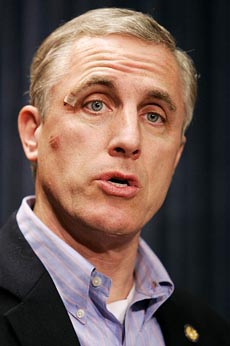
Melissa Meinzer, of the Pittsburgh City Paper reports that Murphy used his campaign staff to begin gathering information on everyday citizens who didn't understand how unAmerican it was to write a letter to the editor opposing Murphy's policies. Meinzer reported on an internal campaign memo to Murphy from his campaign manager. Here's what she wrote:
"The following is the information I was able to retrieve on the individuals who wrote negative letters to the editor about you," reads the beginning of a three-page memo dated June 23, 2006. The memo, addressed to "TFM," was apparently written by Murphy campaign manager Justin Lokay.

The memo includes copies of two letters to the Post-Gazette from earlier that month. The first, by Brian Rampolla, criticizes Murphy's claims that a visit to Iraq had shown him the war was going well and getting better by the day. The second, by Christine Gallo, echoes Rampolla's statements.

In addition to Rampolla's and Gallo's addresses and phone numbers, the documents detail Rampolla's voting record and religion, his stances on gun control and abortion, and his place of business -- as well as his supposed support for Rick Santorum's Democratic opponent in the 2000 U.S. Senate race. Gallo's voting record and place of business are also noted in the document.
Meizner also mentioned in her report that the memo had been uploaded and linked to the Wiki article on Murphy. Coincidentally, a few hours after the Meizner article appeared, and anonymous editor deleted the links from the Wiki article. Gee, wonder who and why? Fortunately, on the internets, almost nothing is ever gone for good. I've replaced the link on Wiki, but, just in case Murphy or his henchmen again delete the Wiki links, here's the section with the links restored:
The documents that have been leaked by Murphy's staff so far include:

* a document that shows “background research” performed by staff members on constituents who wrote letters to the editor
* documents that indicate campaign work being handled through the DO,
* a document showing a planned teleconference with John Braebender, a media consultant for Rick Santorum. Oh, and if Reprehensible Murphy's own personal G. Gordon does manage to make the linked documents disappear, lemme know, because I have also downloaded them.

A Bite 'o the Cheesesteak to Capitol Ideas with John Micek for Meizner's article.

(photo credits: Reprehensible Murphy, Haraz N. Ghanbari, Associated Press, via Post-Gazette; Nixon, unknown)

UPDATE:
Since Reprehensible Murphy (i) keeps his e-mail a secret and (ii) accepts e-mail through the HR server only from constituents, I sent an e-mail to his Communications Director inviting comment and also asking a few questions, like whether Murphy had ever had anyone else checked out this way and whether his staff had anything to do with the disappeared Wiki links. So far, they have ignored the e-mail.

Tuesday, October 31, 2006

Scranton Paper Shills for Casey

Demonstrating, once again, that he and his capos at the Scranton Times ShamrockTimes-Tribune/Wilkes-Barre Citizen's Voice, or whatever they are calling themselves these days, Borys Don't-Spell-My-Name-Wrong Krawczeniuk has another missive direct from the Casey Campaign, posing as his "independent observations" -- what the STSTTWBCV laughingly calls a news report.

Today's STSTTWBCV contains another pandering piece by the Casey Campaign's chief press agent rising to the defense of their boy against the Santorum "aiding and abetting" terrorists claim. The article covers all the angles of the story, well, at least all the angles of Casey's rebuttal to Santorum. (And, not for nuthin', but Casey wouldn't need to rely on a shill if he was actually out on the campaign trail.) It is what the article doesn't say which is galling. Once again, as usual for this rag, and contrary to the practices of ethical journalists everywhere, nowhere is there any mention of the hundreds of thousands of dollars which the owners of the Scranton Times have shoved into Casey's pockets over the years.

It is unusual, to say the least, for owners and editors of newspapers to be so heavily invested in a political candidate which their papers is supposed to objectively cover. A search of the FEC database reveals zero contributions to political candidates from any of the other NEPA newspaper owners, editors and reporting staff. Besides handing over wads of cash, and never providing a disclaimer to their readers, the owners of the Scranton Times have also engaged in dubious advertising of their newspaper which featured falsified headlines touting Casey, which some have said were illegal campaign donations.

All that is fine and, while giving tons of money to a politician is more than a little questionable from the standpoint of journalistic ethics, it is (presumably) legal. But for the Scranton Times to pretend to objectively cover the Senate Race without disclosing to their readers the stake that the ownership of the newspaper has in the outcome is journalistic fraud. They should be ashamed, except they are from NEPA, where we hear that such things are rather routine. So, we expect the owners of the paper to further disrespect their family heritage, give the finger to real journalists everywhere, and continue Trashing the First Amendment.

Monday, October 16, 2006

Losing Election Could Be Costly for Santorum

Could Rick Santorum lose his McMansion if he loses the election?

Close followers of the ethical trainwreck that is Rick Santorum will recall the infamous special interest loan he received from the exclusive Philadelphia Trust Company on his Virginia residence.

The ethical issues surrounding this questionable deal were carefully researched and explicated in a great piece of writing by Will Bunch and in the ethics complaint filed by CREW.

A brief recap. As everyone knows, when Santorum first ran for the Senate, he blasted his incumbent opponent for living in Virginia and not Pennsylvania. When Santorum was elected, he promptly moved his family to Virginia, which has been his principle residence ever since. (The law provides that elected representatives don't lose their legal residency in their home state because they move to DC during their terms. But, two issues still arise -- the law says nothing about Virginia and, more important, instead of fessing up about living in Virginia, he lies about living in Penn Hills.) In any event, eventually he bought a 5,700+ square foot home in Virginia. In 2002, he refinanced the mortgage on the home with Philadelphia Trust. The problem is that Philadelphia Trust is a private banking institution servicing only the very wealthiest clients and, according to the reports he filed as Senator, Santorum doesn't qualify. Will Bunch's research pretty clearly demonstrates that Santorum trashed ethical rules to pull down favorable treatment on his mortgage. Check out the Will Bunch story and CREW complaint for the details.

What I find intriguing is that the mortgage calls for a balloon payment on November 1, 2007. The Santorums took out a five-year mortgage on their cottage home, presumably amortized over a longer period of time.

I guess Santorum figured he'd be re-elected in 2006 and and running for President in 2007. In that event, he likely planned on calling in another chip from Philadelphia Trust. But, since he will not be reelected and will not even be a Pennsylvania resident in 2007, what's going to happen when the (self-described) cash-strapped Santorums have to make that big payment in November, 2007?

Maybe Karen Santorum will have to take a part-time, minimum wage, no benefit job working the cash register at a Virginia Walmart to make ends meet.

One could wish.

In reality, Santorum is likely headed to a high-six-figure job with Haliburton or some lobbying firm, when he can put his connections and disregard for ethical considerations to work for some real coin.

[Oops. I forgot -- hat tip to Santorum Cybergate for the pictures, which I believe are their originals.]

Saturday, October 07, 2006

Trashing the First Amendment

The First Amendment to the United States Constitution is extremely unique -- even within our unique Constitution. The First Amendment not only protects the freedom of speech of citizens (a first at the time), but also a private business -- it establishes the right of "the press" to operate without Government interference:
Congress shall make no law respecting an establishment of religion, or prohibiting the free exercise thereof; or abridging the freedom of speech, or of the press; or the right of the people peaceably to assemble, and to petition the Government for a redress of grievances.
The intent of protecting the institution of the press must be understood in the context of the fundamental purpose of the representative democracy created by the Constitution under the charter of the Declaration of Independence:
We hold these truths to be self-evident, that all men are created equal, that they are endowed by their Creator with certain unalienable Rights, that among these are Life, Liberty and the pursuit of Happiness.--That to secure these rights, Governments are instituted among Men, deriving their just powers from the consent of the governed . . . .
The press was valued and Constitutionally protected not because a number of the founders may have dabbled in the business. It was valued and protected because the founders understood the crucial role which a free and independent press could (and did) play in securing the Liberty of a nation. Jefferson was explicit in his correspondence to John Jay soon after the Bill of Rights was adopted:
Our liberty cannot be guarded but by the freedom of the press, nor that be limited without danger of losing it.
In Jefferson's view, the freedom protected by the First Amendment was not "merely" the freedom of expression of a nation -- but the Liberty of the Nation. If the Government was legitimate only to the extent of the continued "consent of the governed", the free press was necessary to provide the information required to make that consent an informed one.

But for this to have the intended effect, the nation requires a press which is not only free, but independent. House organs (see Fox News) publishing only what serves the current interest of those in charge of the government does nothing to advance the cause of liberty. Indeed, it is harmful to the continuation of liberty.

Jefferson could have been speaking today when he wrote, in 1785, about how the British government used the press to pacify and control the colonists:
The most effectual engines for this purpose are the public papers . . . You know well that the government always kept a kind of standing army of newswriters who, without any regard to truth or to what should be like truth, invented and put into the papers whatever might serve the ministers. This suffices with the mass of the people who have no means of distinguishing the false from the true paragraphs of a newspaper.
"No means of distinguishing the false from the true paragraphs of a newspaper". The founders recognized that a newspaper not independent from the subject of its coverage -- which has a stake in the outcome or is controlled by the government -- is harmful to the protection of freedom and liberty.

The pre-revolutionary debates in colonial United States encouraged the spread of the newspaper. The first daily newspaper in the United States was published in Philadelphia in the 1780s. During the post-revolutionary period in which the "united States" were struggling define their relationships to one another, newspapers were generally associated with political viewpoints, with many being effectively house organs for one political party or another. Federalists and the anti-federalists did battle in print for the minds of the citizens of the various states.

Significantly, the political persuasion of the publisher and reporters were up front and worn on their sleeves. Citizens sought out multiple newspapers to absorb and follow the debate of the day. After the civil war, when the "united States" became the "United States", that began to change. James Gordon Bennett started his newspaper, the New York Herald, in the 1830s and his independent policies showed the way for newspapers to divorce themselves from party control. (Bennett is generally credited with introducing what, to our sensibility, is as intertwined with journalism as the forward pass is with football -- the interview. Just as football began without a forward pass, the first hundred years of journalism in America was practiced without the news interview or press conference.)

Over the years, in indirect and direct recognition of the vital Constitutional role that the press plays in our representative democracy, professional journalists developed varied codes of ethics and practices. The codes are designed, among other things, to advance the independence -- actual and apparent -- of their publications from the objects of their coverage.

The Society of Professional Journalists, founded in 1909, is one of the leading American professional organizations for journalists. The SPJ has a very straight-forward Code of Ethics which acts almost as a punch-list for effective and ethical journalism. The preamble to that Code pithily sets forth the syllogism we have been laboring on about:
[P]ublic enlightenment is the forerunner of justice and the foundation of democracy. The duty of the journalist is to further those ends by seeking truth and providing a fair and comprehensive account of events and issues. Conscientious journalists from all media and specialties strive to serve the public with thoroughness and honesty. Professional integrity is the cornerstone of a journalist's credibility.
The SPJ Code is divided into simple, apt, and significantly titled first principles and associated general orders:
Seek Truth and Report It
Journalists should be honest, fair and courageous in gathering, reporting and interpreting information.

Minimize Harm
Ethical journalists treat sources, subjects and colleagues as human beings deserving of respect.

Act Independently
Journalists should be free of obligation to any interest other than the public's right to know.

Be Accountable
Journalists are accountable to their readers, listeners, viewers and each other.
Simple. Elegant. (Perhaps too elegant for the ham-handed in some parts. More on that infra.)

Following on these are relatively short lists of goals, prohibitions, and requirements for the ethical journalist seeking to live up to these first principles and general orders of the profession. (As an aside, we have always thought that this code of ethics, and many similar codes with which we are familiar (such as those applicable to lawyers) can be further reduced to a single word: Integrity.)

For today's purpose, we are interested in the Independence principle and, relevantly, here's what the SPJ code of ethics has to say about ethical conduct:
Journalists should:
— Avoid conflicts of interest, real or perceived.
Remain free of associations and activities that may compromise integrity or damage credibility.
— Refuse gifts, favors, fees, free travel and special treatment, and shun secondary employment, political involvement, public office and service in community organizations if they compromise journalistic integrity.
Disclose unavoidable conflicts. . . .
The American Society of Newspaper Editors was formed in the 1920s as the professional society for large circulation newspapers. The very first goal of ASNE was to craft a code of ethics, which they called the "Canons of Journalism".

Their preamble states the reason why:
The First Amendment, protecting freedom of expression from abridgment by any law, guarantees to the people through their press a constitutional right, and thereby places on newspaper people a particular responsibility. Thus journalism demands of its practitioners not only industry and knowledge but also the pursuit of a standard of integrity proportionate to the journalist's singular obligation.
In Article III of the ASNE Code, they address Independence of the journalist thus: Journalists must avoid impropriety and the appearance of impropriety as well as any conflict of interest or the appearance of conflict. They should neither accept anything nor pursue any activity that might compromise or seem to compromise their integrity.

Responsible journals everywhere implement these fundamental principles in a variety of ways. The New York Times prohibits reporters, editorial board members, columnists, editorial writers, and all of its staff from, among other things, participating in partisan politics. Properly, the Times' concern is equal parts prevention of influence and protection of public perception of influence.

Here is part of their ethical code respecting political participation:
Voting, Campaigns and Public Issues

62. Journalists have no place on the playing fields of politics. Staff members are entitled to vote, but they must do nothing that might raise questions about their professional neutrality or that of The Times. . . .

63. Staff members may not themselves give money to, or raise money for, any political candidate or election cause. . . .
"Staff" members are defined as everyone on the journalism side of the paper, from editorial board members down to spot photographers, stringers, and copy boys (do they still have copy boys?).

Similarly, the Los Angeles Times prohibits staff members from contributing to candidates: "Staff members may not engage in political advocacy – as members of a campaign or an organization specifically concerned with political change. Nor may they contribute money to a partisan campaign or candidate."

The Detroit Free Press, preferring "plain language", prohibits such staff involvement and specifically requires disclosure:
6. We are independent and we serve the public
We stand on guard for the public interest.
We champion the people’s right to know.
We serve the public best by fiercely protecting our independence and our reputation. We do not engage in outside activities that could conflict with our duty to the public or lessen the value of our services to the Free Press.
We do not work for pay or as a volunteer in a political campaign or organization. . . .
We do not participate in political activities that diminish our usefulness to the Free Press or could be perceived as a conflict of interest.
We publicly disclose when we have relevant personal or corporate involvement in anything we cover or publish, including when a staff member has a substantial relationship with a person cited in the coverage. . . .
Smaller publications, such as the Virginia Pilot and The Pocono Record similarly prohibit political donations by the staff of the paper. Kim de Bourbon, editor of the Pocono Record, takes a the classic line with her paper. In email correspondence with the Slob, Ms. deBourbon made it plain everyone on her paper -- from the publisher down to the beat reporter -- is prohibited from contibuting to political campaigns.

As she notes, in a small community, and as the only daily paper in town, that policy could result in some difficulty, but they maintain it in order to protect the integrity of the newspaper:
[N]ews employees and all senior managers should refrain from partisan political activity. As editor, I interpret that to include contributions to political campaigns, and all newsroom employees are expected to refrain from local political contributions. That said, this is a small town, and last year we had to deal with two staffers who had relatives running for office. Our editorial page editor’s husband and a news reporter’s brother both ran for judge in the Monroe County Court of Common Pleas, and both were elected. It is beyond reasonable to expect that these two employees did not support their relatives’ run for office, although I’m certain neither made individual financial contributions to their campaigns.
(I happen to have a great deal of respect for the Pocono Record. As Ms. de Bourbon mentions, it is a small town newspaper and they clearly understand that role. They do a marvelous job covering their small corner of the world and have been rightly recognized by their peers for their work. Their editorials, whether on local business development issues, school board politics, of national scandals, are generally clear and well written, lucidly conveying the insights of their editorial board.)

An alert observer will have noticed more sensitivity to these issues over the recent years -- an increasing number of newspapers have public editors or ombudsmen serving as in independent eye on the independent eye. You've also seen an increase in "disclaimers" -- alerts to viewers and readers of an affiliation of possible conflict between the news media and the subject of the report.

The News Hour on PBS will introduce a report on BP officials testifying before Congress with a disclaimer that BP is a sponsor of the show; Keith Olbermann will remind viewers of his bosses' relationships with GE when reporting on an issue affecting GE's interests; ABC news, reporting on the struggles within the Disney Company, reminded viewers of the relationship between the broadcaster's owners and the Mouse House; the same when CBS reports on Viacom.

Does Jim McNeil do this because he thinks his reporter was influence in the coverage by the fact that BP was an advertiser?

Is Olbermann afraid that his report might be affected by his bosses' bosses' boss?

Or does Bob Schieffer worry that the correspondent colored the reporting because Viacom is ultimately responsible for the correspondents' paycheck.

Not hardly. Yet they still do it. Why?

Because they are responsible journalists who realize that it is important to disclose, up front, any information which might be reasonably viewed as a potential conflict, a potential relationship between the object of the coverage and the entity doing the covering, or any information which a critical consumer of the information might want to have in order to reach an informed judgment on the credibility, motivation, or completeness of the report or expressed opinion. It is to protect the integrity of the newsreporting and that kind of disclosure is something that all responsible, ethical journalists routinely provide the consumers of their reports.

Such disclosure is not limited to "objective" news reports, either.

Just as the consumer is entitled to believe, and will in all likelihood believe, that there is no undisclosed relationship between the "news" and its object, they will also assume that an "opinion" is one derived honestly and without the impact of any undisclosed relationship.

A food critic does not review the restaurant owned by his editor's spouse; nor a theater critic a play in which his publisher has invested money. At least honorable journalists don't engage in that conduct and, if the relationship is unavoidable, they disclose the relationship up front.

That is, unless you live in a place where integrity -- in appearance or actuality -- is undervalued. Where ethics are no more than the punch line to a joke.

A place like, Scran'en, Pennsylvania.

There, the current iteration of the Lynett Family gives the finger to ethical journalists everywhere. We've briefly reflected on this before, in "A Matter of Integrity, "Scranton Newspapers Continue Unethical Practices", and "They Just Can't Help Themselves".

The Lynetts, publishers AND editors of the Scranton Times "family" of newspapers -- including the Wilkes-Barre Citizen's Voice, and sundry smaller publications and media outlets, have donated HUNDREDS of THOUSANDS of dollars to Casey campaigns over the years.

Since the Casey-Santorum Senate race began, they have published over 600 articles covering the race. But only rarely is the Lynett Family's financial stake in Casey ever mentions (twice that I could find) -- and then not as a disclaimer, but only when it was an unavoidable part of teh coverage. (Some will be quick to claim a difference between restrictions on a publisher and on the staff. There may be some validity in that claim, where a publisher is merely a remote owner, without even an office in the building, turning over all editorial control to professional journalists. I would disagree, but that is not even the case here. First, the Lynetts are members of the Editorial Board, they are involved in the journalism side of the business. Second, they are not distant owners, they are on site, integrated into the paper's operations. They sign the checks.)

Lynett/Casey Campaign writers, like Borys Krawczeniuk, are easy mouthpieces on whom the Casey team can drop some talking points and have them repeated as supposed independent analysis to the readers of the Lynett rags.

For example, in over fifty columns touching on some part of the campaign, Borys has failed to once tell his readers that his bosses have a huge financial stake in the success of Bobby Casey.

From all appearances, he has been actively supporting the Casey candidacy -- no doubt pleasing the caporegime in the Lynett Family. (During the primary he barely mentioned the Casey opponents -- despite having had an extended face-to-face interview with Pennacchio, he never even filed a report. He never used a single Pennacchio or Casey Sandals press release or announcement; he failed to cover a single one of their events in his area.)

He most recently displayed his faulty ethics in a column touting the FEC's rejection of a Republican complaint that the newspaper's self-advertising violated election laws.

At the beginning of the campaign, the clever Lynett boys put up billboards all over Scran'en. They advertised their rag and included a huge reproduction of a portion of the front page of their paper. What was unusual was that, instead of taking a real front page, they forged one -- and featured a fake story and headline on Bobby Casey. The Republicans cried foul. The FEC recently decided in favor of the Lynett Family (but has published neither the complaint nor the decision on its website).

Dutifully, Borys (who cares more about me spelling his name correctly than about ethics in journalism), trotted out a double BJ piece, satisfying his bosses and their bought man.

In that column, he treated the huge contributions by the Lynetts to Casey campaigns over the years as merely a GOP allegation, denied by the bosses:
As evidence, the GOP cited tens of thousands of dollars in contributions by the owners of the newspaper, the Lynett family, to Mr. Casey’s campaign, those of other Casey family members and other Democratic causes.

From the beginning, Mr. Lynett and Mr. Beaupre denied advocating Mr. Casey’s candidacy or coordinating with the Casey campaign.
A casual reader is presented with Borys's "objective" column setting out mere allegations and denials.

But Borys could have, very simply, made it clear to his readers that the "allegations" were in fact true. Instead, he tells his readers that "Mr. Lynett . . . denied advocating Mr. Casey's candidacy".

A real reporter, with a real newspaper, with real ethics, would have followed up that ridiculous claim by Lynett with something like, "But, Mr. Lynett, how can you say that you do not advocate Mr. Casey's candidacy when you gave him $1,000 on June 29, 2005, another $2,100 check the same day, and $400 more this year?"

A real, ethical journalist would have pointed out that the objective facts show Mr. Lynett to have lied when he claimed not to support Casey's candidacy.

Instead, this tool, this fraud of a journalist, on a fraud of a newspaper, let his readers believe in the lie -- nothing to concern yourself with here, folks, it's all simply the yin and yang of political allegations and denial.

Over six hundred times the Lynett Family has presented the public with articles about the Senate campaign. It is bad enough that they feel themselves above standard ethical practice by shoveling so much money into the pockets of a Senate candidate, but they give the finger to ethical journalists everywhere by lacking the decency to disclose the conflict to readers.

Journalists have sat in jail for principle.

Journalists have died to get the story.

Courageous journalists have been killed because of their story.

People like the Lynetts and their errand boys, like (but not limited to) Borys, don't deserve the honor of being called journalists.